The Problem With “Don’t Kink Shame”
- haleyjw20
- Feb 21
- 3 min read

When I was working at the coffee shop job I had in 2017, I was first introduced to the concept of a “safe space.” I don’t recall my initial reaction to it, but my stance on the matter now, is almost dogmatic. Upon reading the article in the Harvard Political Review, “Tackling the Term: What is a Safe Space,” written by Katherine Ho, there are two common definitions of what dictates a ‘“safe space” – one in an emotional context and the other in an intellectual manner.
Ho cites American journalist, editor and culture critic Judith Shulevitz from a New York Times article. According to Shulevitz, a “safe space” is a haven for inoffensive and unanimous conversations as a preventative for feeling marginalized. These types of groups provide emotional reprieve for some folks, say, the trans community to express themselves without judgement.
The next definition of “safe spaces” derives from an interview on the radio program, On Being with Harvard psychology professor, Mahzarin Banaji. She describes this ideology as the opposite: to provide a containment for students to also openly share, while holding space for uncomfortability. Both Shulevitz and Banaji promote beneficial concepts in academic spaces.
I am not arguing that “safe spaces” shouldn’t exist. I do, however, have strong opinions on the intersection of “safe spaces” and the BDSM community; and what is deemed too far for the sex-positive movement. I am specifically referring to Adult Babies and Diaper Lovers (ABDL).
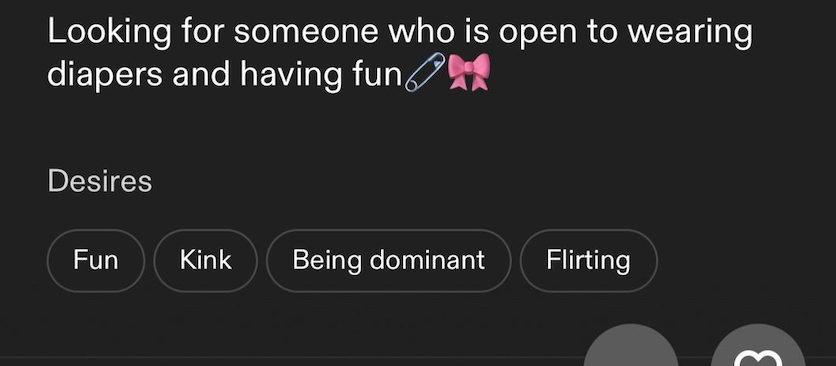
ABDL are a niche group of consenting adults that infantilize themselves in both a sexual and non-sexual manner. Like any BDSM interaction, there are one or more participants. Within ABDL communities, I am referencing a perceived baby, or minor and its caretaker in sexual circumstances. I also want to note that there is a stark difference between folks who have a medical condition and those who choose to wear a diaper as a fetish. I also understand that there are some folks that are utilizing this method of self-expression as a passageway to cope with trauma. In some cases, it is not always sexual.
Minors cannot consent. Role-play centered on infancy or childlike states, are stages of life defined by not having the cognitive ability to consent. Consent is, or at least should be, at the forefront of every adult sexual interaction whether it is BDSM related or otherwise. Yes, all role-play is symbolic of fantasy, I am not denying that. However even among consenting adults, in the case of ABDLs, there is a distinct shift to the eroticization of an individual playing a role as a non-consenting factor. This differs from Consensual Non-Consent, (CNC) due to the fact that both parties possess the capacity to consent, whereas in ABDL, sexual dynamics, the central issue is that it replicates someone who lacks the capacity altogether.
What sparked my interest in this community was when I was single. I was browsing the dating app Feeld, which prides itself on being an all-encompassing space to explore alternative relationships. Let me tell you, I encountered a number of adult babies. Some of which were either looking for a “caretaker” or those who are interested in a participant to wear and defecate in a diaper. I am not interested in being an adult baby or a caretaker.
Nonetheless, there is importance of normalization, as the BDSM and sex-postive communities have faced harsh criticism. Circling back to both Shulevitz and Banaji’s stance on “safe spaces” in both an emotional and intellectual context, and the prominent aspects of facilitating validation of inoffensiveness and uncomfortability. Both these categories within sex-postive facets, can and do exist. However, the contrast is the level of agency one holds. Infantilization in a sexual context does not belong in these spaces, as it counteracts one of the core values of consent.
Sources:
Katherine Ho Ho, Katherine. “Tackling the Term: What Is a Safe Space?” Harvard Political Review, 2016.(Include URL if you’re hyperlinking on your blog.)
Judith Shulevitz Shulevitz, Judith. “In College and Hiding From Scary Ideas.” The New York Times, March 21, 2015.https://www.nytimes.com/2015/03/22/opinion/sunday/hiding-from-scary-ideas.html
Mahzarin Banaji (On Being Interview) Banaji, Mahzarin. Interview by Krista Tippett. On Being. American Public Media, originally aired February 2, 2017.


Comments